File:Fairy of Eagle Nebula.jpg


摘要
| 描述 |
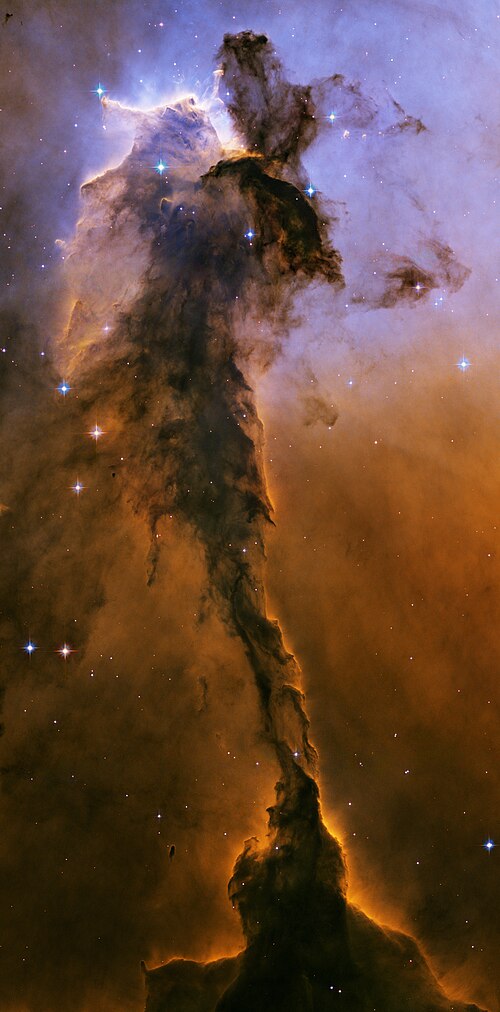
English: The Fairy of Eagle Nebula.
Appearing like a winged fairy-tale creature poised on a pedestal, this object is actually a billowing tower of cold gas and dust rising from a stellar nursery called the Eagle Nebula. The soaring tower is 9.5 light-years or about 90 trillion kilometres high, about twice the distance from our Sun to the next nearest star. Stars in the Eagle Nebula are born in clouds of cold hydrogen gas that reside in chaotic neighbourhoods, where energy from young stars sculpts fantasy-like landscapes in the gas. The tower may be a giant incubator for those newborn stars. A torrent of ultraviolet light from a band of massive, hot, young stars [off the top of the image] is eroding the pillar. The starlight also is responsible for illuminating the tower's rough surface. Ghostly streamers of gas can be seen boiling off this surface, creating the haze around the structure and highlighting its three-dimensional shape. The column is silhouetted against the background glow of more distant gas. The edge of the dark hydrogen cloud at the top of the tower is resisting erosion, in a manner similar to that of brush among a field of prairie grass that is being swept up by fire. The fire quickly burns the grass but slows down when it encounters the dense brush. In this celestial case, thick clouds of hydrogen gas and dust have survived longer than their surroundings in the face of a blast of ultraviolet light from the hot, young stars. Inside the gaseous tower, stars may be forming. Some of those stars may have been created by dense gas collapsing under gravity. Other stars may be forming due to pressure from gas that has been heated by the neighbouring hot stars. The first wave of stars may have started forming before the massive star cluster began venting its scorching light. The star birth may have begun when denser regions of cold gas within the tower started collapsing under their own weight to make stars. The bumps and fingers of material in the centre of the tower are examples of these stellar birthing areas. These regions may look small but they are roughly the size of our solar system. The fledgling stars continued to grow as they fed off the surrounding gas cloud. They abruptly stopped growing when light from the star cluster uncovered their gaseous cradles, separating them from their gas supply. Ironically, the young cluster's intense starlight may be inducing star formation in some regions of the tower. Examples can be seen in the large, glowing clumps and finger-shaped protrusions at the top of the structure. The stars may be heating the gas at the top of the tower and creating a shock front, as seen by the bright rim of material tracing the edge of the nebula at top, left. As the heated gas expands, it acts like a battering ram, pushing against the darker cold gas. The intense pressure compresses the gas, making it easier for stars to form. This scenario may continue as the shock front moves slowly down the tower. The dominant colours in the image were produced by gas energized by the star cluster's powerful ultraviolet light. The blue colour at the top is from glowing oxygen. The red colon in the lower region is from glowing hydrogen. The Eagle Nebula image was taken in November 2004 with the Advanced Camera for Surveys aboard the NASA/ESA Hubble Space Telescope.Español: «El hada» de la nebulosa del Águila (M16) es un pilar retorcido de polvo y gas molecular. Imagen obtenida con la cámara avanzada para sondeos (ACS) del telescopio espacial Hubble.
Français : La Fée de la Nébuleuse de l’Aigle (Eagle Nebula).
Polski: „Wróżka” z Mgławicy Orzeł.
Italiano: La Fata (Colonna V) della Nebulosa Aquila.
Македонски: „Самовилата“ на маглината Орел.
Português: "A Fada" da Nebulosa da Águia (M16) é um pilar retorcido de gás estelar e poeira. Imagem obtida pelo telescópio espacial Hubble em novembro de 2004. |
| 日期 | |
| 来源 | |
| 作者 | NASA, ESA, and The Hubble Heritage Team (STScI/AURA) |
评价
|




|
English: The Fairy of Eagle Nebula. 其他语言:
English: The Fairy of Eagle Nebula. Español: «El hada» de la nebulosa del Águila (M16) es un pilar retorcido de polvo y gas molecular. Imagen obtenida con la cámara avanzada para sondeos (ACS) del telescopio espacial Hubble. Français : La Fée de la Nébuleuse de l’Aigle (Eagle Nebula). Italiano: La Fata (Colonna V) della Nebulosa Aquila. Polski: „Wróżka” z Mgławicy Orzeł. Português: "A Fada" da Nebulosa da Águia (M16) é um pilar retorcido de gás estelar e poeira. Imagem obtida pelo telescópio espacial Hubble em novembro de 2004. Македонски: „Самовилата“ на маглината Орел. |
|
|
这张图片被选为孟加拉语维基百科上的每日图片。
|
许可协议

|
此文件属于公有领域,因为它是由NASA和ESA创建的。NASA哈勃望远镜资料(以及2009年之前的ESA哈勃望远镜资料)不受版权保护,可以像公有领域资料一样自由使用,但前提是必须注明NASA、STScI和/或ESA为资料来源。如果使用的是2008年之后创建的ESA资料或来自其他机构的资料,则此许可不适用。
本材料由太空望远镜科学研究所根据合同NAS5-26555为NASA制作,或由哈勃欧洲航天局信息中心为ESA制作。版权声明见hubblesite.org或2008版权声明见spacetelescope.org。 对于自2009年以来由欧洲航天局在spacetelescope.org网站上创建的内容,请使用{{ESA-Hubble}}标签。 |
.jpg)
|
文件历史
点击某个日期/时间查看对应时刻的文件。
| 日期/时间 | 缩略图 | 大小 | 用户 | 备注 | |
|---|---|---|---|---|---|
| 当前 | 2018年9月3日 (一) 06:01 | | 3,856 × 7,804(30.36 MB) | SteinsplitterBot | Bot: Image rotated by 90° |
| 2017年12月5日 (二) 20:01 |  | 7,804 × 3,857(27.08 MB) | Kulandru mor | redone from lossless TIFF, less noise, included original ICC profile | |
| 2010年5月16日 (日) 08:32 |  | 7,804 × 3,857(37.64 MB) | Tryphon | Original size, from http://hubblesite.org/newscenter/archive/releases/2005/12/image/b/ (http://imgsrc.hubblesite.org/hu/db/images/hs-2005-12-b-full_jpg.jpg). | |
| 2007年12月11日 (二) 13:47 |  | 2,590 × 1,280(350 KB) | Analiza | {{Information |Description= |Source= |Date= |Author= |Permission= |other_versions= }} |
文件用途
以下页面使用本文件:
全域文件用途
以下其他wiki使用此文件:
- af.wikipedia.org上的用途
- ar.wikipedia.org上的用途
- ast.wikipedia.org上的用途
- be-tarask.wikipedia.org上的用途
- be.wikipedia.org上的用途
- bg.wikipedia.org上的用途
- bn.wikipedia.org上的用途
- ca.wikipedia.org上的用途
- ckb.wikipedia.org上的用途
- crh.wikipedia.org上的用途
- cs.wikipedia.org上的用途
- cv.wikipedia.org上的用途
- de.wikipedia.org上的用途
- de.wiktionary.org上的用途
- el.wikipedia.org上的用途
- en.wikipedia.org上的用途
- en.wikibooks.org上的用途
- en.wikiquote.org上的用途
- es.wikipedia.org上的用途
查看此文件的更多全域用途。

