


File:NGC 6745.jpg

本预览的尺寸:623 × 599像素。 其他分辨率:250 × 240像素 | 499 × 480像素 | 755 × 726像素。
原始文件 (755 × 726像素,文件大小:516 KB,MIME类型:image/jpeg)


摘要
| 描述 |
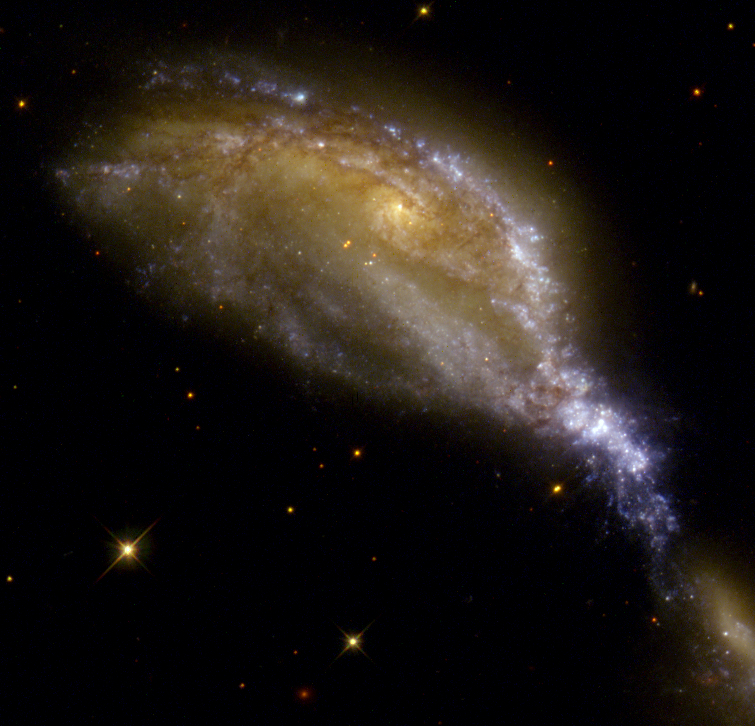
A Bird's eye view of a Galaxy Collision What appears as a bird's head, leaning over to snatch up a tasty meal, is a striking example of a galaxy collision in NGC 6745. A large spiral galaxy, with its nucleus still intact, peers at the smaller passing galaxy (nearly out of the field of view at lower right), while a bright blue beak and bright whitish-blue top feathers show the distinct path taken during the smaller galaxy's journey. These galaxies did not merely interact gravitationally as they passed one another, they actually collided. When galaxies collide, the stars that normally comprise the major portion of the luminous mass of each of the two galaxies will almost never collide with each other, but will pass rather freely between each other with little damage. This occurs because the physical size of individual stars is tiny compared to their typical separations, making the chance of physical encounter relatively small. In our own Milky Way galaxy, the space between our Sun and our nearest stellar neighbor, Proxima Centauri (part of the Alpha Centauri triple system), is a vast 4.3 light-years. However, the situation is quite different for the interstellar media in the above two galaxies - material consisting largely of clouds of atomic and molecular gases and of tiny particles of matter and dust, strongly coupled to the gas. Wherever the interstellar clouds of the two galaxies collide, they do not freely move past each other without interruption but, rather, suffer a damaging collision. High relative velocities cause ram pressures at the surface of contact between the interacting interstellar clouds. This pressure, in turn, produces material densities sufficiently extreme as to trigger star formation through gravitational collapse. The hot blue stars in this image are evidence of this star formation. This image was created by the Hubble Heritage Team using NASA Hubble Space Telescope archive data taken with the Wide Field Planetary Camera 2 in March 1996. Members of the science team, which include Roger Lynds (KPNO/NOAO) and Earl J. O'Neil, Jr. (Steward Obs.), used infrared, red, visual and ultravoilet filters to image this galaxy system. Lynds and O'Neil are currently using the Hubble data along with ground-based radio observations to further study the interactions within NGC 6745. Image Credit: NASA and The Hubble Heritage Team (STScI/AURA) Acknowledgment: Roger Lynds (KPNO/NOAO) |
| 日期 | |
| 来源 | The Goddard Library |
| 作者 | NASA Goddard Space Flight Center NASA-GSFC |

|
本图像或视频收录于美国国家航空航天局 (NASA)戈达德航天中心(Goddard Space Flight Center),其照片编号是: GL-2002-001105 此标签不表示文件的著作权状态。任何文件在附有此标签的同時还需要一个有效的著作权标签。请参阅许可协议说明页面以了解更多信息。 其他语言:
|
许可协议

|
此文件属于公有领域,因为它是由NASA和ESA创建的。NASA哈勃望远镜资料(以及2009年之前的ESA哈勃望远镜资料)不受版权保护,可以像公有领域资料一样自由使用,但前提是必须注明NASA、STScI和/或ESA为资料来源。如果使用的是2008年之后创建的ESA资料或来自其他机构的资料,则此许可不适用。
本材料由太空望远镜科学研究所根据合同NAS5-26555为NASA制作,或由哈勃欧洲航天局信息中心为ESA制作。版权声明见hubblesite.org或2008版权声明见spacetelescope.org。 对于自2009年以来由欧洲航天局在spacetelescope.org网站上创建的内容,请使用{{ESA-Hubble}}标签。 |
.jpg)
|
原始上传日志
(All user names refer to en.wikipedia)
- 2006-02-06 00:35 Ryanrs 755×726×8 (528025 bytes) [http://library01.gsfc.nasa.gov/search/images/imageslist.php?id=115&searchterm=everything&searchfield=entire NASA Goddard Library]
- 2005-09-25 23:18 Hurricane Devon 500×481×8 (13644 bytes)
文件历史
点击某个日期/时间查看对应时刻的文件。
| 日期/时间 | 缩略图 | 大小 | 用户 | 备注 | |
|---|---|---|---|---|---|
| 当前 | 2007年5月31日 (四) 05:01 | | 755 × 726(516 KB) | Spyder Monkey | {{Information |Description=''no original description'' |Source=Originally from [http://en.wikipedia.org en.wikipedia]; description page is/was [http://en.wikipedia.org/w/index.php?title=Image%3ANGC_6745.jpg here]. |Date=2005-09-25 (first version); 2006-02 |
文件用途
以下页面使用本文件:
全域文件用途
以下其他wiki使用此文件:
- ar.wikipedia.org上的用途
- arz.wikipedia.org上的用途
- az.wikipedia.org上的用途
- be.wikipedia.org上的用途
- br.wikipedia.org上的用途
- ca.wikipedia.org上的用途
- ce.wikipedia.org上的用途
- cs.wikipedia.org上的用途
- cy.wikipedia.org上的用途
- de.wikipedia.org上的用途
- en.wikipedia.org上的用途
- en.wikiversity.org上的用途
- eo.wikipedia.org上的用途
- es.wikipedia.org上的用途
- eu.wikipedia.org上的用途
- fa.wikipedia.org上的用途
- fr.wikipedia.org上的用途
- hr.wikipedia.org上的用途
- id.wikipedia.org上的用途
- ja.wikipedia.org上的用途
- kk.wikipedia.org上的用途
- ko.wikipedia.org上的用途
- lb.wikipedia.org上的用途
- mg.wikipedia.org上的用途
- mk.wikipedia.org上的用途
- nl.wikipedia.org上的用途
- nn.wikipedia.org上的用途
- pl.wikipedia.org上的用途
- pt.wikipedia.org上的用途
- ro.wikipedia.org上的用途
- rue.wikipedia.org上的用途
- ru.wikipedia.org上的用途
查看此文件的更多全域用途。

