


File:Ngc1999.jpg


摘要
| 描述 |
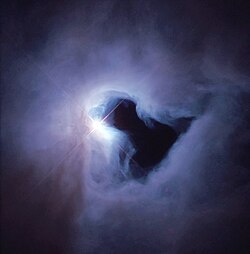
English: Just weeks after NASA astronauts repaired the Hubble Space Telescope in December 1999, the Hubble Heritage Project snapped this picture of NGC 1999, a nebula in the constellation Orion. The Heritage astronomers, in collaboration with scientists in Texas and Ireland, used Hubble's Wide Field Planetary Camera 2 (WFPC2) to obtain the color image.
NGC 1999 is an example of a reflection nebula. Like fog around a street lamp, a reflection nebula shines only because the light from an embedded source illuminates its dust; the nebula does not emit any visible light of its own. NGC 1999 lies close to the famous Orion Nebula, about 1,500 light-years from Earth, in a region of our Milky Way galaxy where new stars are being formed actively. The nebula is famous in astronomical history because the first Herbig-Haro object was discovered immediately adjacent to it (it lies just outside the new Hubble image). Herbig-Haro objects are now known to be jets of gas ejected from very young stars. The NGC 1999 nebula is illuminated by a bright, recently formed star, visible in the Hubble photo just to the left of center. This star is cataloged as V380 Orionis, and its white color is due to its high surface temperature of about 10,000 degrees Celsius (nearly twice that of our own Sun). Its mass is estimated to be 3.5 times that of the Sun. The star is so young that it is still surrounded by a cloud of material left over from its formation, here seen as the NGC 1999 reflection nebula. The WFPC2 image of NGC 1999 shows a remarkable jet-black cloud near its center, resembling a letter T tilted on its side, located just to the right and lower right of the bright star. This dark cloud is an example of a "Bok globule," named after the late University of Arizona astronomer Bart Bok. The globule is a cold cloud of gas, molecules, and cosmic dust, which is so dense it blocks all of the light behind it. In the Hubble image, the globule is seen silhouetted against the reflection nebula illuminated by V380 Orionis. Astronomers believe that new stars may be forming inside Bok globules, through the contraction of the dust and molecular gas under their own gravity. NGC 1999 was discovered some two centuries ago by Sir William Herschel and his sister Caroline, and was cataloged later in the 19th century as object 1999 in the New General Catalogue. These data were collected in January 2000 by the Hubble Heritage Team with the collaboration of star-formation experts C. Robert O'Dell (Rice University), Thomas P. Ray (Dublin Institute for Advanced Study), and David Corcoran (University of Limerick). |
| 日期 | 摄于2000年1月21日 |
| 来源 | https://hubblesite.org/contents/media/images/2000/10/952-Image.html; see also https://apod.nasa.gov/apod/ap000302.html |
| 作者 | NASA and The Hubble Heritage Team (STScI) |
评价
|




许可协议

|
此文件属于公有领域,因为它是由NASA和ESA创建的。NASA哈勃望远镜资料(以及2009年之前的ESA哈勃望远镜资料)不受版权保护,可以像公有领域资料一样自由使用,但前提是必须注明NASA、STScI和/或ESA为资料来源。如果使用的是2008年之后创建的ESA资料或来自其他机构的资料,则此许可不适用。
本材料由太空望远镜科学研究所根据合同NAS5-26555为NASA制作,或由哈勃欧洲航天局信息中心为ESA制作。版权声明见hubblesite.org或2008版权声明见spacetelescope.org。 对于自2009年以来由欧洲航天局在spacetelescope.org网站上创建的内容,请使用{{ESA-Hubble}}标签。 |
.jpg)
|
文件历史
点击某个日期/时间查看对应时刻的文件。
| 日期/时间 | 缩略图 | 大小 | 用户 | 备注 | |
|---|---|---|---|---|---|
| 当前 | 2006年10月18日 (三) 20:14 | | 1,563 × 1,590(1.13 MB) | Tom | higher res |
| 2006年7月19日 (三) 02:11 |  | 750 × 763(411 KB) | The viewer | {{PD-USGov-NASA}} |
文件用途
全域文件用途
以下其他wiki使用此文件:
- af.wikipedia.org上的用途
- ar.wikipedia.org上的用途
- az.wikipedia.org上的用途
- bat-smg.wikipedia.org上的用途
- be.wikipedia.org上的用途
- br.wikipedia.org上的用途
- ca.wikipedia.org上的用途
- ce.wikipedia.org上的用途
- cs.wikipedia.org上的用途
- da.wikipedia.org上的用途
- de.wikipedia.org上的用途
- diq.wikipedia.org上的用途
- el.wikipedia.org上的用途
- en.wikipedia.org上的用途
- Star
- Portal:Astronomy/Picture/July 2005
- NGC 1999
- Portal:Astronomy/Picture/29 July 2005
- Herschel 400 Catalogue
- User:DarkAvenger
- User:Sir Drance
- User:Jw21/deUBdomain
- User:Jw21/deUBdomain/God crying
- User:It's-is-not-a-genitive/IE
- User talk:It's-is-not-a-genitive/IE
- V380 Orionis
- User:Themoridian/Fate
- User:Uhtred of Bebbanburg
- Wikipedia:Featured picture candidates/December-2008
- Wikipedia:Featured picture candidates/NGC 1999
- User:Secret Saturdays
- Template:Did you know nominations/V380 Orionis
- User:ElectricController
- en.wikiquote.org上的用途
- W. H. Auden
- Talk:W. H. Auden
- The Sandman (comic book)
- LSD
- The Hitchhiker's Guide to the Galaxy
- Nikos Kazantzakis
- Wikiquote:Quote of the day/March 2011
- Wikiquote:Quote of the day/March 22, 2011
- Wikiquote:Quote of the day/April 2011
- Wikiquote:Quote of the day/April 15, 2011
- Nothingness
- Future
- God
- User:Kalki/images-physics
- Zack Snyder's Justice League
查看此文件的更多全域用途。

