


File:Ngc2392.jpg


摘要
|


| 描述 |
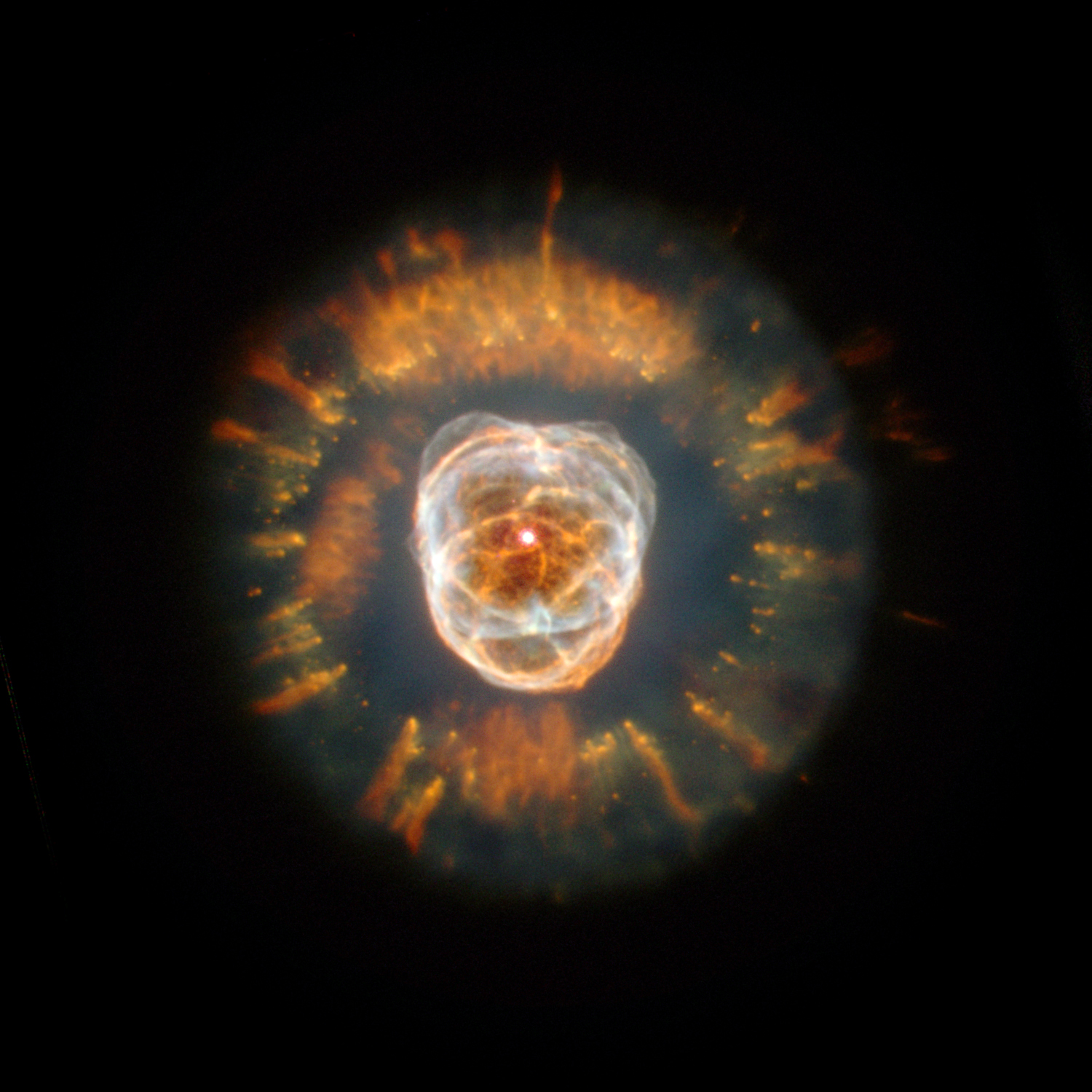
English: Eskimo nebula (NGC 2392). In its first glimpse of the heavens following the successful December 1999 servicing mission, NASA's Hubble Space Telescope captured a majestic view of a planetary nebula, the glowing remains of a dying, Sun-like star. This stellar relic, first spied by William Herschel in 1787, is nicknamed the "Eskimo" Nebula (NGC 2392) because, when viewed through ground-based telescopes, it resembles a face surrounded by a fur parka.
In this Hubble telescope image, the "parka" is really a disk of material embellished with a ring of comet-shaped objects, with their tails streaming away from the central, dying star. The Eskimo's "face" also contains some fascinating details. Although this bright central region resembles a ball of twine, it is, in reality, a bubble of material being blown into space by the central star's intense "wind" of high-speed material. In this photo, one bubble lies in front of the other, obscuring part of the second lobe. Scientists believe that a ring of dense material around the star's equator, ejected during its red giant phase, created the nebula's shape. The bubbles are not smooth like balloons but have filaments of denser matter. Each bubble is about 1 light-year long and about half a light-year wide. Scientists are still puzzled about the origin of the comet-shaped features in the "parka." One possible explanation is that these objects formed from a collision of slow-and fast-moving gases. The Eskimo Nebula is more than 2,870 light-years from Earth in the constellation Gemini. The picture was taken Jan. 10 and 11, 2000, with the Wide Field and Planetary Camera 2. The nebula's glowing gases produce the colors in this image: nitrogen (red), hydrogen (green), oxygen (blue), and helium (violet). |
|||
| 日期 | ||||
| 来源 | http://www.spacetelescope.org/images/heic9910a/ | |||
| 作者 | NASA, ESA, Andrew Fruchter (STScI), and the ERO team (STScI + ST-ECF) | |||
| 授权 (二次使用本文件) |
|
|||
| 其他版本 | 此文件衍生的作品: EvolutionSystèmeSolaire-fragment1.png |

.jpg)



文件历史
点击某个日期/时间查看对应时刻的文件。
| 日期/时间 | 缩略图 | 大小 | 用户 | 备注 | |
|---|---|---|---|---|---|
| 当前 | 2005年7月28日 (四) 12:34 | | 1,500 × 1,500(1.16 MB) | Startaq | |
| 2005年2月1日 (二) 17:20 |  | 320 × 259(12 KB) | CWitte | Eskimo nebula |
文件用途
以下8个页面使用本文件:
全域文件用途
以下其他wiki使用此文件:
- af.wikipedia.org上的用途
- ar.wikipedia.org上的用途
- arz.wikipedia.org上的用途
- ast.wikipedia.org上的用途
- az.wikipedia.org上的用途
- be.wikipedia.org上的用途
- bg.wikipedia.org上的用途
- bn.wikipedia.org上的用途
- bs.wikipedia.org上的用途
- ca.wikipedia.org上的用途
- ce.wikipedia.org上的用途
- cs.wikipedia.org上的用途
- cv.wikipedia.org上的用途
- da.wikipedia.org上的用途
- de.wikipedia.org上的用途
- diq.wikipedia.org上的用途
- el.wikipedia.org上的用途
- en.wikipedia.org上的用途
- Planetary nebula
- Compact object
- Eskimo Nebula
- List of planetary nebulae
- User:Anticipation of a New Lover's Arrival, The/Galleries/Awards
- Caldwell catalogue
- Herschel 400 Catalogue
- User:Reginhild
- Wikipedia:Featured picture candidates/May-2007
- Wikipedia:Featured picture candidates/Eskimo Nebula
- User:Reginhild/Userboxes/Space Scientist
查看此文件的更多全域用途。

