


Transport (字体)
 | |
| 樣式 | 无衬线体 |
|---|---|
| 分類 |
|
| 設計師 | |
| 創造日期 | 1957-1963 |
 | |
| 範例 | |

Transport 是首个设计用于英国交通标志的无衬线体字体。它由Jock Kinneir和Margaret Calvert从1957至1963设计,作为交通局Anderson和Worboys委员会设计师的工作。[1][2]
历史
[编辑]Before its introduction, British road signs used the capitals-only Llewellyn-Smith alphabet that was introduced following the Maybury Report of 1933 and revised in 1955–57. Older signs, known as fingerposts, tended to use a variety of 无衬线体 alphabets as supplied by their manufacturers. For the kinds of roads on which either of these alphabets was likely to be seen, legibility was not a pressing issue, but the planning and building of Britain's first 高速公路 in the 1950s was a catalyst for change.
The Ministry of Transport appointed an Advisory Committee on Traffic Signs for Motorways under the chairmanship of Sir Colin Anderson in 1957 and Jock Kinneir and his assistant Margaret Calvert were appointed as 平面设计ers to it. All aspects of signing were investigated and tested, initially on the 普雷斯顿 (兰开夏郡) bypass (1958, now part of the M6高速公路 (英國)), before their introduction on the (伦敦–約克郡) M1高速公路 (英國) a year later. The committee looked at examples from other European countries as well as the USA but Kinneir and Calvert found them somewhat harsh and unsatisfactory. Instead, they developed a more rounded typeface with distinctive tails to 'a', 't', and 'l', and bar-less 分數, all of which helped legibility.
The department, seeing the successful early results of this work then appointed another committee, under the chairmanship of Sir Walter Worboys and again using Kinneir and Calvert as designers, to look at Traffic Signs for All-Purpose Roads. Work for this also resulted in the introduction of the pictogram signs based on those recommended by the 國際駕駛執照.
特征
[编辑]Two forms of the typeface exist: Transport Medium and Transport Heavy. Both have the same basic form, but Transport Heavy is boldface, to allow easier readability of black letters on white backgrounds, such as those used on non-primary roads, while Transport Medium is lighter, and is used for white letters on dark backgrounds, such as the green primary-route signs.[3]
The Transport fonts are the only ones allowed on UK road signs (except for motorway signs, where route numbers appear in their own separate typeface known as Motorway).[4]: Regulation 5 and Schedule 17
Only a limited number of symbols are available in Transport, mainly those commonly used in road signs, such as 撇号s, the £ and certain 分數s such as ½ and ⅓. The original Transport fonts contained no 附加符号s, but since the publication of the 2016 Traffic Signs Regulations and General Directions includes 重音符s for use on road signs in Scotland.[4]
英国以外的道路交通标志
[编辑]Although developed for road signage in the United Kingdom, the typeface has seen use in the British government website and some government letters. It has also been used for road signage in many other countries around the world; in addition to the 王室屬地, 英國海外領土 and some limited residual usage in 英联邦, the typeface is also used in Hong Kong, Iceland, Ireland, Greece (on non-motorway roads), Portugal, and in much of the Middle East, often with adaptations to include diacritics and other letters not used in English.
- Transport was expanded with the Greek alphabet to be used in Greece. In Greece and other such countries where non-拉丁字母 文字 (such as the 波斯字母系統) are used, Transport is often used for Latin 字母转写s.[1][5]
- Road signs in the Republic of Ireland use 全部大写 Transport Heavy for English names. Irish names are set in mixed-case Transport Heavy 伪斜体 with modifications to certain letters - a is changed to a Ɑ, i (which was formerly dotless) has a curve on the bottom, and A, M and N are tall copies of their lowercase forms.
- Denmark uses a modification with added spacing and changes to the J and numerals, known as Dansk Vejtavleskrift.
In Indonesia, electronic 資訊可變標誌 have used Transport since April 2014.[6]
在道路交通标志使用Transport的国家
[编辑]- Bangladesh
- Greece (Greek letters added)
- 香港
- Iceland
- India
- Indonesia (variable message signs only)
- Iran
- Ireland
- Italy (bolder variant called Alfabeto Normale and a condensed width thereof called Alfabeto Stretto)
- Kuwait
- 马来西亚
- Malta
- Nepal
- 新西兰(Parking Area signs only)
- Oman
- Portugal
- Qatar
- 新加坡(Parking Area signs only)
- Spain (bolder variant called Carretera Convencional)
- United Arab Emirates
设计
[编辑]New Transport
[编辑]It is an updated and expanded version of the original typeface, been developed by Henrik Kubel of A2/SW/HK Limited and Margaret Calvert during 2012.
The original release includes six different weights (Thin, Light, Regular, Medium, Bold, Black) with complementary 伪斜体 stylings. It also has other features including 不齐线数字 and 小型大写字母.[8] Semibold weight was added between 2 August 2018[9] and 2 September 2018.[10]
GDS Transport
[编辑]Transport New
[编辑]An updated though unofficial family based upon Transport was first released by independent foundry K-Type in 2008. The family includes Light, Medium and Heavy weights along with true italics which were added in 2015.[13]
其他
[编辑]图库
[编辑]-

-
 Example of the use of the typeface in road signs in Portugal
 -
 Irish road sign using special character forms for A, a, i, and capitals M and N, for Irish text
 -
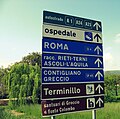 Use of Alfabeto Normale, as well as Alfabeto Stretto (top and bottom signs), in Italy
 -
 The typeface is in use on Icelandic road signs. This example shows the locations of villages and farms in a rural area of the country.
 -
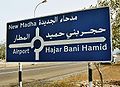
-
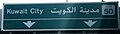 Another example of the typeface in use in the Middle East, this time in Kuwait.
 -

-
 The Transport font is used in several ex-British colonies, such as this one in 卡蓋拉區, Tanzania
 -
 Latest street direction sign with Transport typeface in 旺角, Hong Kong
 -
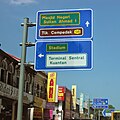 Gantry road sign with Transport typeface used in 马来西亚
 -
 Use of the typeface in Greece


参见
[编辑]- Motorway (字体) — 用于高速公路的公路编号的字体,同样由Kinneir & Calvert设计。
- Rail Alphabet — 用于英国铁路的类似字体,同样由Kinneir & Calvert设计。
- Johnston — 伦敦地铁字体,由Edward Johnston设计。
- Public signage typefaces
- 联邦高速公路字体 — 北美变体,全球通用道路交通标志字体
- DIN 1451 — The German equivalent.
参考文献
[编辑]- ^ 1.0 1.1 Design Museum — Jock Kinneir + Margaret Calvert (页面存档备份,存于互联网档案馆), URL accessed 16 May 2006
- ^ Calvert, Margaret. New Transport. A2-Type. [1 March 2016]. (原始内容存档于2015-05-11).
- ^ Traffic Signs Manual (Chapter 1) (PDF): 18. [2023-12-16]. ISBN 9780115536014. (原始内容 (PDF)存档于2023-12-16).
- ^ 4.0 4.1 The Traffic Signs Regulations and General Directions 2016. legislation.gov.uk. [22 July 2024]. (原始内容存档于2024-05-30).
- ^ FAQ §3.6 Fonts on signs (页面存档备份,存于互联网档案馆) from Chris's British Road Directory
- ^ Indonesia Transport Minister's Rule No. 13/2014 互联网档案馆的存檔,存档日期6 October 2014.
- ^ Transport. MyFonts. URW++. [1 March 2016]. (原始内容存档于2022-06-03).
- ^ New Transport. New Transport. [19 June 2017]. (原始内容存档于2015-05-11).
- ^ New Transport, Typeface (2019-08-29)
- ^ New Transport, Typeface (2019-09-02)
- ^ A few notes on typography. GOV.UK. [19 June 2017]. (原始内容存档于2014-01-04).
- ^ Can I use the GOV.UK fonts? – Design in government. designnotes.blog.gov.uk. [2026-02-21]. (原始内容存档于2025-11-17).
- ^ Transport New. K-Type. [17 June 2017]. (原始内容存档于2025-11-11).
- ^ FF Nort. MyFonts. [12 March 2021]. (原始内容存档于2021-03-08).
- ^ FF Nort Headline. MyFonts. [12 March 2021]. (原始内容存档于2021-01-27).
外部链接
[编辑]- Traffic signs working drawings: TSRGD 2016 schedule 17 (页面存档备份,存于互联网档案馆)
- World Transportation Organization The world transportation organization (The Non-Profit Advisory Organization)
New Transport
[编辑]- New Transport (页面存档备份,存于互联网档案馆) – sale, history and .pdf specimen
- A2-TYPE page (页面存档备份,存于互联网档案馆)