


Eigengrau


_at_ISO_6400_(detail).jpg)
在黑暗中观察到的噪声范例
Eigengrau(德语:Eigengrau,直译:“本征灰”,发音:[ˈʔaɪ̯gŋ̍ˌgʁaʊ̯] ⓘ),又称Eigenlicht(德语:Eigenlicht,直译:“本征光”),是许多人在没有可见光的情况下所看到的均匀深灰色背景色。
词源
[编辑]“Eigenlicht”一词可追溯至19世纪[3],但在20世纪科学出版物中鲜少使用。对于此现象,常见的科学术语包括“视觉噪声”或“背景适应”。这些术语的产生,源于人们在此现象中会感知到不断变化的黑白小点场域[4][5]。
特征
[编辑]在正常照明条件下,Eigengrau被感知为比黑色物体更亮,因为对比度对视觉系统而言比绝对亮度更重要。例如,夜空因为星星所提供的对比,看起来比Eigengrau更暗[6]。
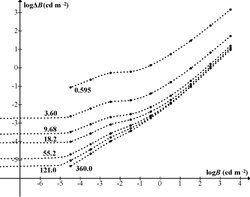
由布莱克威尔收集、克鲁米绘制的对比度阈值数据,显示Eigengrau出现在适应亮度值低于约10− 5 cd m−2(25.08 mag arcsec−2)时。这是Ricco定律的极限情况[1][2]。
成因
[编辑]研究人员早在1860年就注意到,强度–敏感度曲线的形状可以用假设视网膜内部存在本征噪声源,产生与真正光子触发事件无法区分的随机事件来解释[7][8]。后来对海蟾蜍(Rhinella marina)视杆细胞的实验显示,这些自发事件的频率与温度高度相关,这意味着它们是由视紫红质的热异构化所引起[9]。在人类视杆细胞中,这些事件平均每100秒发生一次,考虑到视杆细胞内视紫红质分子的数量,这意味着视紫红质分子的半衰期约为420年[10]。这些事件与光子的反应在视觉上无法区分,这一现象支持了“视紫红质的热异构化”解释,因为视紫红质位于转导链的输入端。另一方面,像神经传导物质自发释放等过程则无法完全排除[11]。
参见
[编辑]参考
[编辑]- ^ 1.0 1.1 Blackwell HR. H. Richard Blackwell, Contrast Thresholds of the Human Eye. Journal of the Optical Society of America Vol. 36, Issue 11, pp. 624-643 (1946)
 . Journal of the Optical Society of America. 1946, 36 (11): 624–643. PMID 20274431. doi:10.1364/JOSA.36.000624.
- ^ 2.0 2.1 Crumey, Andrew. Human contrast threshold and astronomical visibility. Monthly Notices of the Royal Astronomical Society. 2014, 442 (3): 2600–2619. arXiv:1405.4209
 . doi:10.1093/mnras/stu992 .
- ^ Ladd, Trumbull. Direct control of the retinal field.. Psychological Review. 1894, 1 (4): 351–55. doi:10.1037/h0068980.
- ^ Hansen RM, Fulton AB. Background adaptation in children with a history of mild retinopathy of prematurity. Invest. Ophthalmol. Vis. Sci. 2000-01, 41 (1): 320–24. PMID 10634637.
- ^ Davis, Ben. There Are So Many Amazing Colors You Don’t Even Know About!. Artnet. 2024-08-20 [2024-08-20]. (原始内容存档于2025-04-19).
- ^ Wallach, Hans. Brightness Constancy and the Nature of Achromatic Colors. Journal of Experimental Psychology. 1948, 38 (3): 310–24. PMID 18865234. doi:10.1037/h0053804.
- ^ Barlow, H.B. Dark and Light Adaptation: Psychophysics.. Visual Psychophysics. New York: Springer-Verlag. 1972. ISBN 978-0-387-05146-8.
- ^ Barlow, H.B. Retinal and Central Factors in Human Vision Limited by Noise. Vertebrate Photoreception
 . New York: Academic Press. 1977. ISBN 978-0-12-078950-4.
- ^ Baylor, D.A.; Matthews, G; Yau, K.-W. Two components of electrical dark noise in toad retinal rod outer segments. Journal of Physiology. 1980, 309: 591–621. PMC 1274605 . PMID 6788941. doi:10.1113/jphysiol.1980.sp013529.
- ^ Baylor, Denis A. Photoreceptor Signals and Vision. Investigative Ophthalmology & Visual Science. 1987-01-01, 28 (1): 34–49. PMID 3026986.
- ^ Shapley, Robert; Enroth-Cugell, Christina. Visual Adaptation and Retinal Gain Controls. Progress in Retinal Research. 1984, 3: 263–346. doi:10.1016/0278-4327(84)90011-7.


